KCl seed · oxy-hydrogen · strong recuperation · vacuum jacket · C60 back-contact at 7–10 suns. The evidence build — every claim carries its figure and its regen command.
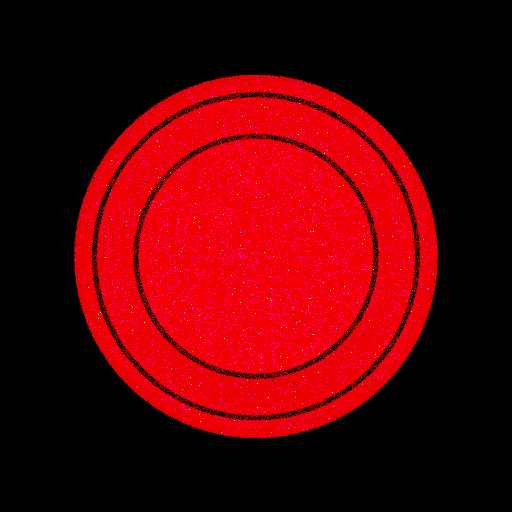
eye-dim, silicon-bright — the K frame pair
what the cell sees at 767 nm [MODEL — render, guided-cavity K radiance]what the eye sees [MODEL — photometric honest dim; 767 sits at the eye's edge]
same photons, two judgments: near-dark to the eye, full-power to the silicon. That is the whole potassium thesis in two frames.
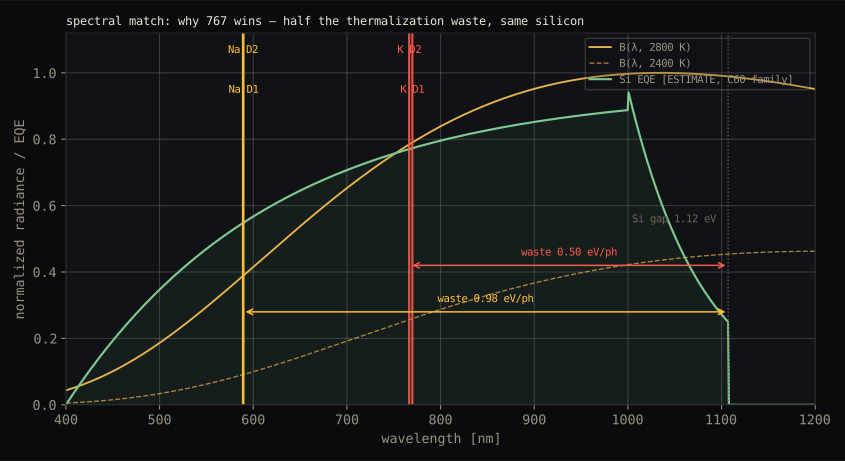
1 · spectral match — why 767 wins
Na D (589) and K doublet (766.5/769.9) over the Si EQE curve [ESTIMATE, C60 family] and B(λ, 2400/2800 K). Thermalization waste shaded: 0.98 eV/ph (Na) vs 0.50 eV/ph (K). regen: uv run --python 3.12 --with numpy --with matplotlib python flasmon/fig_k_spectral.py
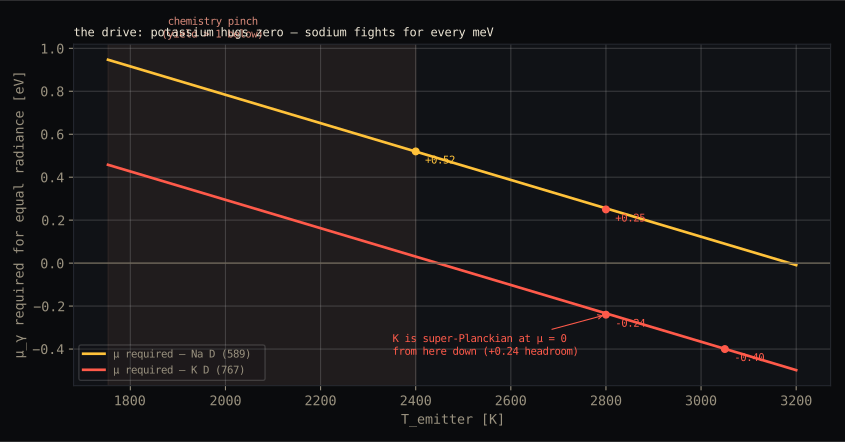
2 · the drive — potassium hugs zero
μ_γ required for equal radiance (row-18 inversion): at 2400 K, Na needs +0.52, K needs +0.03; at 2800 K, K is super-Planckian at μ = 0 by +0.24 eV. The pinch that was marginal for sodium evaporates for potassium. regen: uv run --python 3.12 --with numpy --with matplotlib python flasmon/fig_k_drive.py
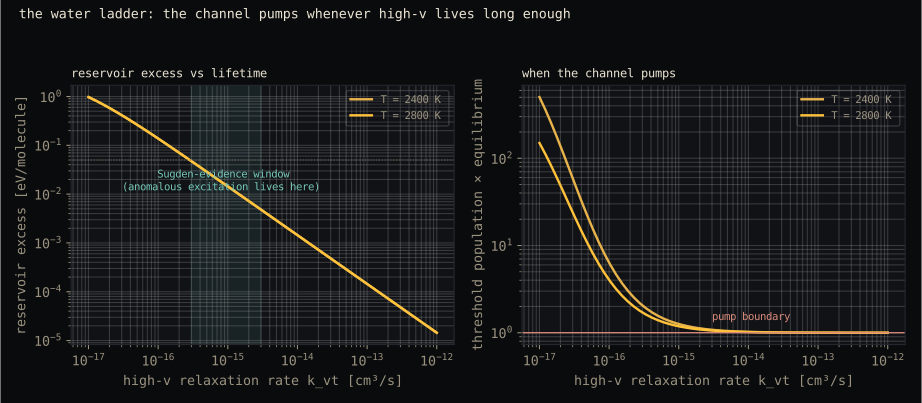
3 · the water ladder — when the channel pumps
oxy-hydrogen's product is H₂O born vibrationally excited; the manifold is the inversion. Regime map from flasmon/water_ladder.py: the alkali channel pumps whenever the high-v states live longer than ~10⁻¹⁵ cm³/s-class — the Sugden-evidence window. [nascent E_v ESTIMATE 1.7 eV; coupling ESTIMATE, Sugden-era lineage] regen: uv run --python 3.12 --with numpy --with matplotlib python flasmon/fig_k_ladder.py
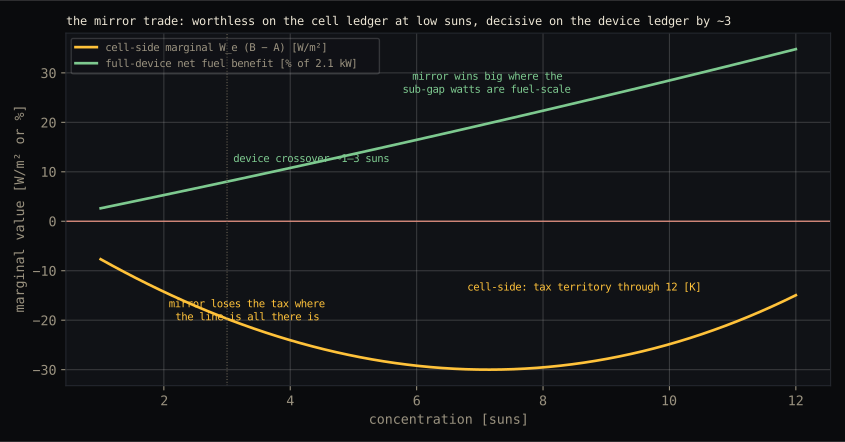
4 · the mirror trade — two ledgers, two crossovers
a trade, not a presumed win: the C60 rear metallization already returns 50–80% of sub-gap photons [ESTIMATE, coupon owed]. With η_mono credited, the K cell-side stays in tax territory through 12 suns (−30 W/m² at 7, −15 at 12); the device ledger earns from ~1–3 suns, +19% at 7 → +35% at 12. Sub-gap content of a 2800 K cavity: 70% [computed — quadrature fixed 2026-07-21; the 39% previously shown here carried a grid-spacing factor]. regen: uv run --python 3.12 --with numpy --with matplotlib python flasmon/fig_k_mirror.py
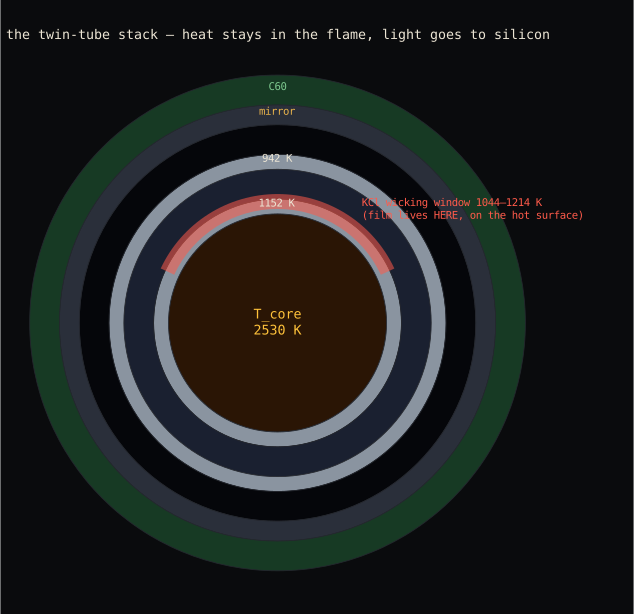
5 · the twin-tube stack
gas core → inner quartz → condensation annulus → outer quartz → vacuum → heat-mirror facet → C60. With the mirror credited: T_core = 2530, T_inner = 1152, T_outer = 942 K. The KCl wicking window (1044–1214 K) lands exactly on the inner tube surface — the film lives there, pure salt, no eutectic, no molten bath [DESIGN]. regen: uv run --python 3.12 --with numpy --with matplotlib python flasmon/fig_k_twin.py
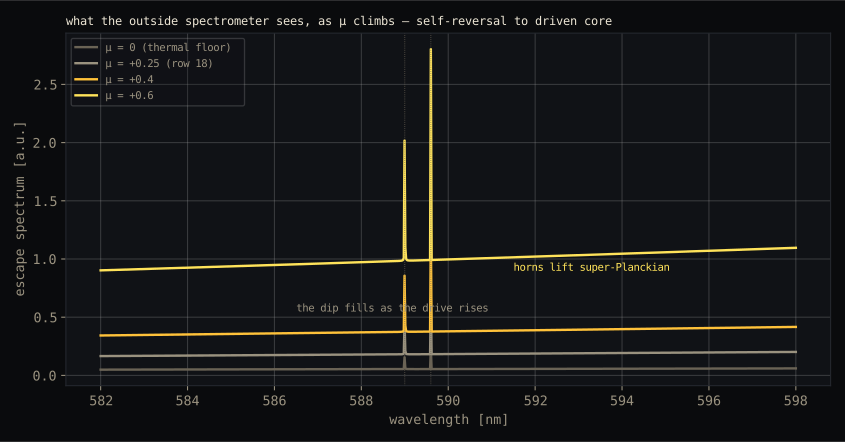
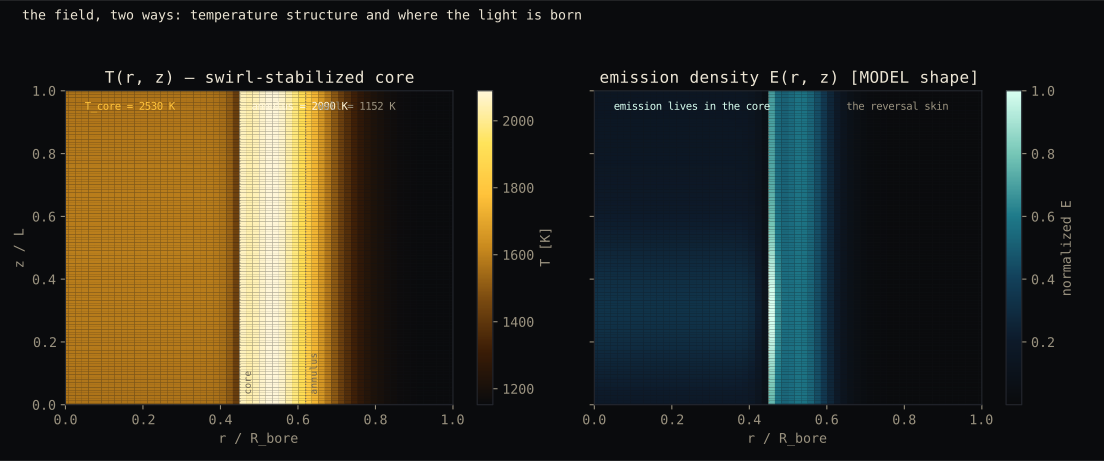
6 · the device from outside — escape spectra and fields
what a spectrometer outside the device sees as the drive rises: the escaping spectrum at μ_γ = 0 / +0.25 / +0.40 / +0.60 eV — κ-ladder escape rows × generalized-Planck source. Self-reversal deepens before the wings lift: the degree of self-reversal is a secondary gauge of the radiatively pumped potential [MODEL]. regen: uv run --python 3.12 --with numpy --with matplotlib python flasmon/fig_p_escape.pythe solved fields: T(r,z) with core/annulus/wall structure and the emission-density companion — same style as the twin-tube stack, here as maps [MODEL — static-merge machinery]. regen: uv run --python 3.12 --with numpy --with matplotlib python flasmon/fig_p_fields.py
the sodium flasmon was the proof; the potassium flasmon is the product — half the photon waste, a pinch that evaporates, a cell that was already made for it.
the ledger
driveequal-radiance drive: μ_K = μ_Na − 0.489 eV. At 2800 K the K line is super-Planckian at μ = 0 by +0.24 eV of headroom; the chemistry pinch relaxes from yield ≈ 1 (Na at 2400) to ≈ 0.1–0.15 (K). [reconstructed | ESTIMATE cycle ~2× faster]couplingoxy-hydrogen removes CO₂ — the only true drain (thermalizes, never re-excites). The alkali-H₂O channel is a coupling whose direction the reservoir sets: it pumps when the ladder is driven, quenches only when cold [frame: water_ladder.py].cascadeNa(3p) → K(4p) E–E transfer (exothermic 0.489 eV): Na = antenna, K = emitter. Transfer efficiency 3% @10% K, 15% @50%, 24% @90% [ESTIMATE k_EE = 10⁻¹⁰]; the ladder threshold at 1.616 eV is ~7× more populated than at 2.105 eV.system pointvacuum jacket (radiation-only wall), KCl loop (mp 1044 K — easier than NaCl), strong recuperation (η = 0.9). Model steady state: T_core ≈ 2530 K, T_annulus ≈ 2090 K, T_wall ≈ 1210 K, P_line ≈ 550 W at 2.1 kW fuel.suns on cellr2 matrices, 0.847 electrical capture: 7 suns needs 7,470 W radiated → 2.2 kW_e (ΔT_cell = 40 K, η_mono = 0.352); 10 suns needs 10,680 W radiated → 2.8 kW_e (ΔT_cell = 60 K, η_mono = 0.314) [derived: EQE 0.99 [T NREL/SPWR 2013] × diode theory, −1.75 mV/K; FF 0.80 MODEL pending bench I-V]. Achievable at the anticipated regimes: device side is a 30–70 kW-fuel class at β ≈ 0.3 [β: MODEL design class — not measured; see ROW18-INHERITANCE-AUDIT]; cell side holds with liquid-class cooling in the ΔT = 20–60 K band — each 10 K of cell temperature costs ~0.9% absolute, so the fin design is priced, not decorative.
costs and open questions
K(4p) cross sections ~1.5× Na(3p) [ESTIMATE] — σ_H is the single biggest unknown in the K quench budget. K chemistry is less characterized than Na's — the KOH/KH cycle is structurally analogous but its rates carry [ESTIMATE] throughout. ion loss channel: 27× ionization cuts both ways — K⁺ drift to walls is a real sink at design densities. KCl corrosivity ≈ NaCl; materials program inherits unchanged. the overshoot coupling ([K]/[KOH] ∝ s) mirrors sodium's breathing [MODEL]. FF 0.80 is [MODEL] — one bench I-V sweep under the Na source closes FF, Voc1, and high-injection at once; it is the top recommended measurement. current density is 1.5× the naive broadband estimate: 67 A/full-cell at 7 kW/m² 767 nm — split-3 (22 A/strip) is the baseline at the design point; split-5 holds 21 kW/m² at 40 A/strip; resistive loss fraction ∝ X/n². C60 Gen3 packaging: tin-barrier metallization + chloride sealing at the salt-loop interface [T-sheet]; −0.29%/K n-type derate folded into every η_mono above.
what was run — regenerate everything
figure / artifact
script
command
output
k-spectral.svg/.png
flasmon/fig_k_spectral.py
uv run --python 3.12 --with numpy --with matplotlib python fig_k_spectral.py
✓ deployed
k-drive.svg/.png
flasmon/fig_k_drive.py
uv run --python 3.12 --with numpy --with matplotlib python fig_k_drive.py
✓ deployed
k-ladder.svg/.png
flasmon/fig_k_ladder.py
uv run --python 3.12 --with numpy --with matplotlib python fig_k_ladder.py
✓ deployed
k-mirror.svg/.png
flasmon/fig_k_mirror.py
uv run --python 3.12 --with numpy --with matplotlib python fig_k_mirror.py
✓ deployed
k-twin.svg/.png
flasmon/fig_k_twin.py
uv run --python 3.12 --with numpy --with matplotlib python fig_k_twin.py
✓ deployed
p-escape.svg/.png
flasmon/fig_p_escape.py
uv run --python 3.12 --with numpy --with matplotlib python fig_p_escape.py
✓ deployed
p-fields.svg/.png
flasmon/fig_p_fields.py
uv run --python 3.12 --with numpy --with matplotlib python fig_p_fields.py